Walmart to let AI agents shop for customers; sets guardrails

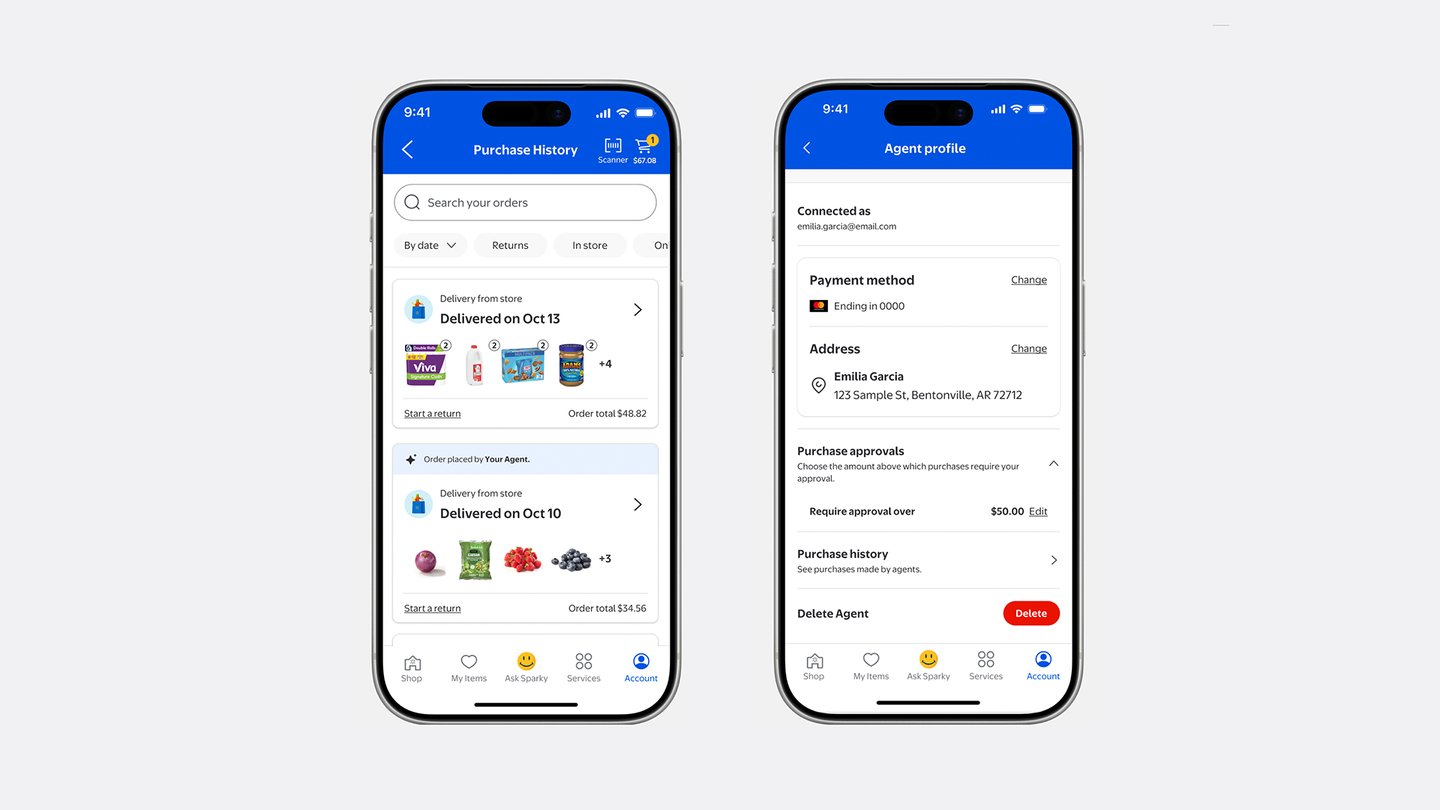
Walmart is rolling out tools that will allow customers to use their own artificial intelligence tools to shop, but with built-in permissions, controls and protections.
The retail giant is introducing three solutions designed to control the process of outside agents performing shopping tasks on behalf of Walmart and Sam’s Club customers: Agent Profiles, the Walmart Agent Gateway and terms for AI agents. A
Agent Profiles
Launching in the next month, Agent Profiles will let customers authorize each AI agent with a dedicated profile within their account, so they will be able to see the agent’s purchases separately from the rest of their purchases.
In addition, customers will be able to determine how they want to approve purchases. They can require approval for every purchase or provide permission for the agent to make purchases within a spending limit they set – such as $50, $100 or $200.
Walmart says the prices that an AI agent sees are the same prices that a human would see on Walmart.com, with applicable offers and fees shown before purchase.
The first time a customer uses an agent to shop through the Walmart Agent Gateway (see details below), Walmart will automatically create an Agent Profile for that agent. Shoppers will authorize and link that Agent Profile to the account by signing into their Walmart account. Only Walmart will see this.
Customers can choose a spending limit and see purchases from every agent and delete an Agent Profile at any time.
Walmart Agent Gateway
The Walmart Agent Gateway is being designed to give agents a faster, more reliable way to shop by using an MCP (model text protocol), beginning with a beta for companies and developers. The Agent Gateway will also assist agents in finding commonly shopped items for individual customers without the agents having to share a user’s broader shopping history.
Terms for AI agents
Walmart is setting rule establishing what agents can and cannot do when shopping on behalf of a Walmart customer:
- Customers are in control, and Walmart’s returns process applies – including if an agent doesn’t act as intended.
- Customers must approve agent purchases by default, and Walmart may require additional approvals even for purchases within an agent’s spending limits.
- Agents must not take actions beyond what the shopper intends.
- Agents don’t receive customers’ payment-card information and can’t add or change a customer’s payment methods.
- Agents can only have access to the information needed for the task and allowed by the customer.
- The agent’s privacy policy applies to the information it receives. The company that provides the agent handles what a customer sharse with its app under its privacy policy. Walmart collects and processes information the agent provides in accordance with its privacy standards.
- Agents that do not follow these terms will be blocked from Walmart’s site.
“We’ve always worked to understand what customers need and make shopping easier for them,” Walmart said in a corporate blog post. “As customers begin using agents to help them shop, we’re building connections, permissions and options that complement those tools and support how customers want to use them. It’s just another way we’re living our commitment to serve customers and earn the trust they place in us every day.
Walmart offers proprietary AI shopping tools
In addition to accepting third-party shopping agents, Walmart offers a number of its own AI tools for customers. These include an in-app ChatGPT shopping experience.
And in October 2025, Walmart launched a collaboration with OpenAI which allowed Walmart and Sam’s Club shoppers to complete purchases directly within ChatGPT. The feature was based on "instant checkout," an offering from OpenAI that enables users to discover, browse and purchase items directly from partner retailers within the ChatGPT environment.
[READ MORE: Walmart to enable shopping directly in ChatGPT]
Walmart also built an agentic shopping experience with Google which is accessible directly within the Gemini AI model using the Universal Commerce Protocol (which allows AI agents to shop and make purchases for consumers across different online stores).
Other proprietary AI shopping tools include a smiling "Ask Sparky" button in Walmart’s mobile app which customers can use across all product categories to find items and synthesize reviews, as well as to conduct natural-language custom product searches.
In contrast, chief Walmart rival Amazon offers a range of proprietary AI shopping tools but currently bans third-party shopping agents from its e-commerce site.
Based in Bentonville, Ark., Walmart Inc. runs 10,900 stores and numerous e-commerce websites in 19 countries. Sam’s Club, a division of Walmart Inc., operates more than 600 stores in the U.S. and Puerto Rico.