EXCLUSIVE: Q&A with VP of Amazon Robotics on company’s robotics strategy


Amazon supports fast delivery and heavy order volumes with a growing fleet of advanced fulfillment robots.
Chain Store Age recently visited Amazon’s Boston-area robotics R&D and manufacturing hub in Westborough, Mass. to take a first-hand look at the latest advances in the robots the retailer uses in its fulfillment centers. During the visit, which took place on the first day of Amazon Prime Day 2026, we spoke with Scott Dresser, VP of Amazon Robotics, to get deeper insight into the online giant’s robotics strategy.
What are the key guiding principles of Amazon's robotics program?
Safety is always first. We need to make sure that the systems and the robotics that we develop are safe around our associates, because they are inherently in the same spaces as our associates.
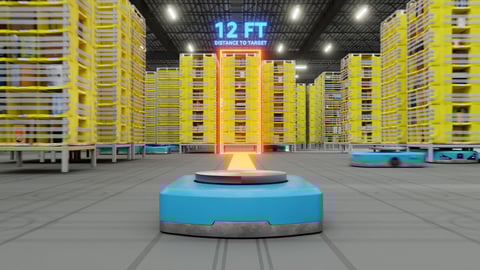
Proteus (Amazon’s first fully autonomous mobile robot) is a good example. As Amazon started the Proteus development program, the core innovation was to make sure that we could develop a system that was always safe around our employees.
There was a lot of design iteration about how to make a system that had safe sensors and software so that we could reliably test it and verify it to make sure that was safe around people.
Amazon also thinks about speed. Customers love speed, they love ordering products and getting them in as little as 30 minutes, which they can in some cases. Robots enable us to build fulfillment operations that are denser and closer to our customers, and that combined with artificial intelligence and work we're doing in inventory placement means that we can provide transportation times that are much less than they would be otherwise.
Beyond safety, how do you see robots working with your human associates?
This goes all the way back in our long history of having robots bring materials and goods to people, rather than having them walk around a fulfillment operation trying to find a product. That goods-to-person system is more effective, because employees are not spending their time walking miles around a fulfillment operation finding goods.
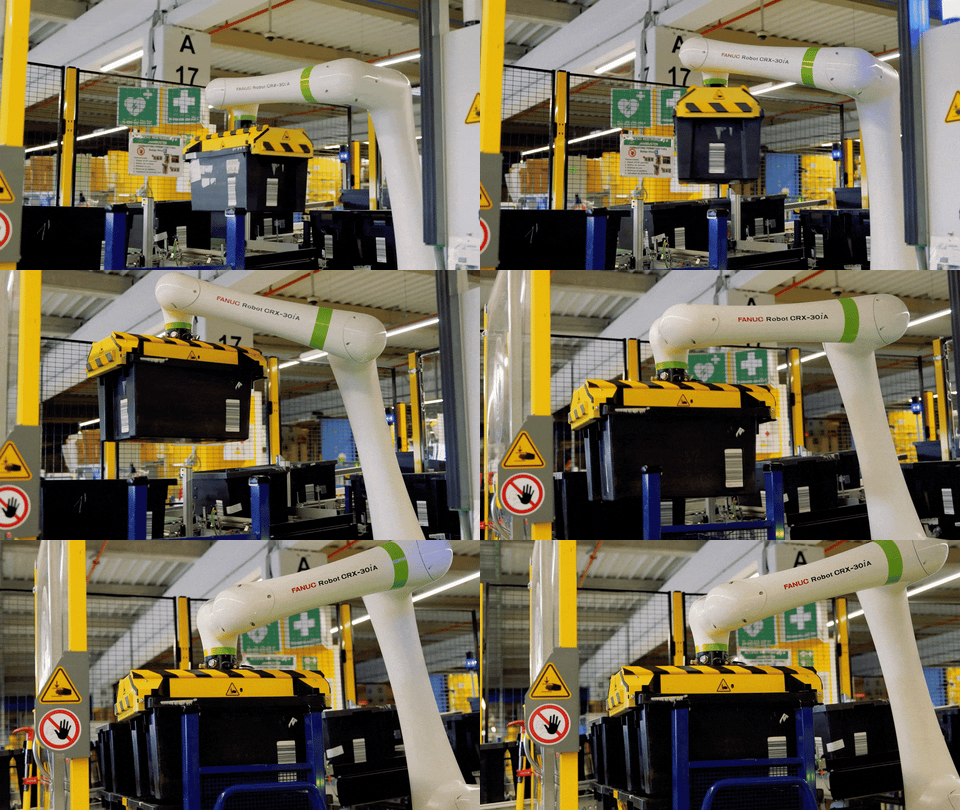
Amazon’s newest generation of robotic systems deliver products at an ergonomically friendly height. If we can deliver products to the human associates in a tote or container that's directly in front of them, it makes their job that much easier.
We have people moving and lifting carts. Any robot needs to be able to work in the same spaces as they are and allow employees to continue to do their jobs without interfering with the with the work that they're trying to accomplish. This is a much higher, harder technology lift, and some of the recent advances in AI and robotics have enabled us to accomplish that goal.
How is Amazon integrating voice and advanced AI technology into your fulfillment robots?
We have announced that the next generation of Proteus will have voice. Proteus Two will be available by the end of the year, and people will be able to interact with it through a language interface or a voice command interface. This will allow Amazon employees to ask Proteus to do something for them, such as lift something up or move it to a certain location.
[READ MORE: Amazon hits major robot milestone; launches new robotics AI model]
Or maybe a Proteus robot would be in a place where employees need to perform maintenance work so they would ask it to move out of the way. The natural way to do that is to walk up to the robot, ask it to do something, and have it respond, rather than have to go through another tool or interface.
Employees will be able to use conversational language, so they can say something like, ‘Proteus, pick up this pallet and move it around this operational cart.’ The robot could respond in a natural language way, or maybe respond with lights and sound, or go forward as well to acknowledge the fact that it received the command and is off and running.
Almost all the robots Amazon is developing today run what we call physical AI models that allow them to perceive the world around them. They have cameras and sensors that allow them to see what's going on and perceive the world in front of them and then based on the work at hand figure out how to accomplish their tasks and take action.
This is the physical AI model. Physical AI enables our warehouse robots like Proteus and Sparrow, an intelligent robotic system that detects, selects and handles individual products in its inventory, because they both perceive the world around them, have a task that they're trying to accomplish, and then have to take an understanding of what the task is and what the environment is through their sensing and turn that into robotic actions like moving, lifting, or navigating through space and figuring out which route is less congested.
AI is helping us make our robots more effective around people, but more efficient in the operation as well, too.
How do peak sales events like Prime Day or Cyber Monday affect Amazon’s robotics strategy?
They are obviously an important part of it. Amazon has millions of orders running through our system and we do a lot of planning and preparation ahead of time to make sure the robots are running at peak performance during events like Prime Day. The robots are all running to deliver on behalf of customers and make sure that when customers place their order for Prime Day, they are getting them within the expected time period.