
Placer.ai: Gen Z consumers fueling 2026's shopping center traffic


Malls have seen sustained year-over-year visit increases this year, with one age cohort leading the way.
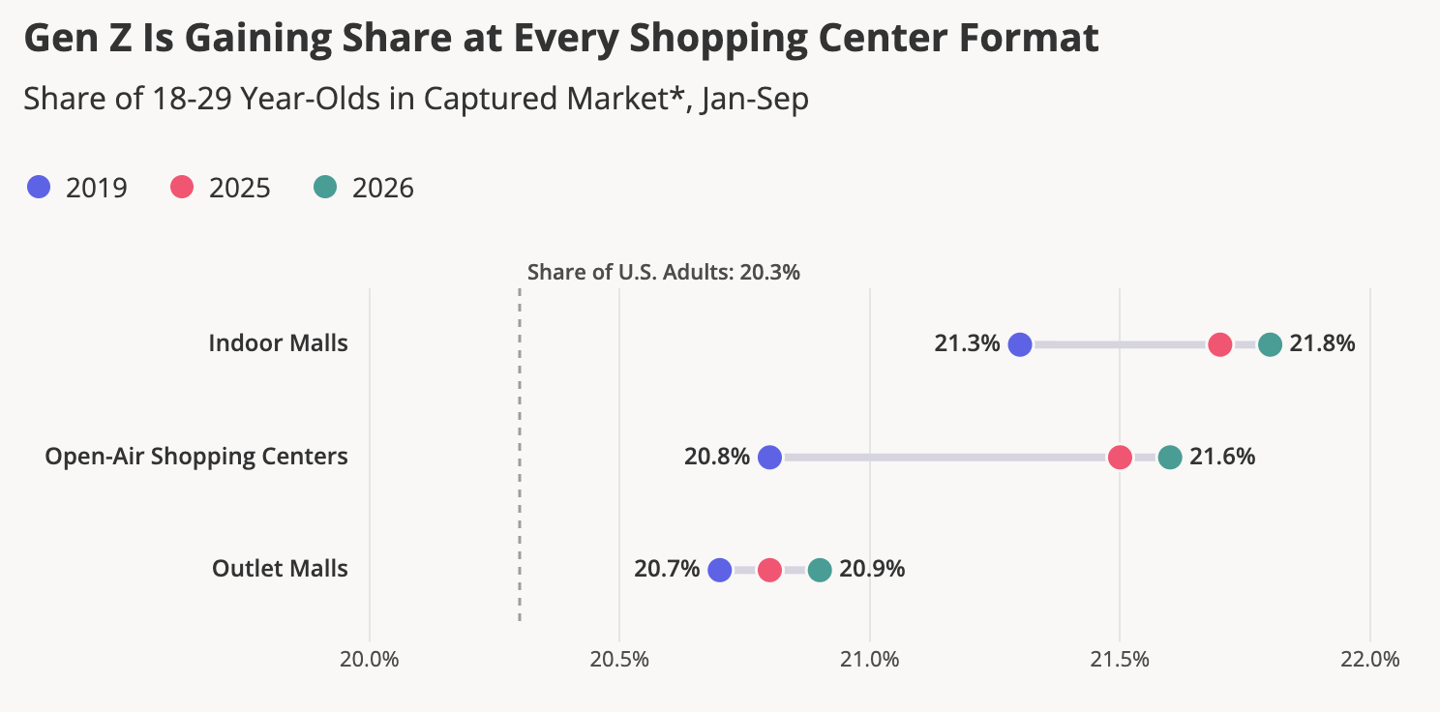
Retail data firm Placer.ai’s latest white paper, “Gen Z at the Mall: Shopping Habits, Visit Patterns, and Winning Brands,” reveals that young adults ages 18 to 29 are visiting shopping centers of all types above their 20.3% share of the U.S. adult population.
Between January and September 2026, Gen Z represented 21.8% of indoor malls’ captured markets, 21.6% of open-air shopping centers’ captured markets, and 20.9% of outlet malls’ captured markets. The age cohort’s representation has also risen across every format since 2019.
[READ MORE: Placer.ai: Malls continued visit growth momentum in October]
The report found that “mid-tier centers,” roughly equivalent to Class B properties, led on young adult share in the first nine months of 2026, with Gen Z accounting for 22.7% of their captured markets. “Top-tier centers,” roughly equivalent to Class A properties, followed at 21.3%, while premium properties (Class A+) stood at 20.9%. All three property types stood above the national benchmark with Gen Z visitors.
“If atmosphere and experience were the primary draw, premium centers – with their destination tenant rosters and elevated dining offerings – might be expected to lead the ranking,” noted Placer.ai. “Instead, mid-tier centers came out on top, likely because they are more geographically dispersed and often closer to where young people live, work, and study. For a generation that prizes value and convenience, the mall where shopping is easiest may hold more appeal than the mall where lingering is nicest.”
Tenants are also playing an important role in attracting Gen Z guests. Within the Placer.ai Open-Air Shopping Center Index, Trader Joe’s and Target outdrew their host centers on 18-to-29-year-old share by 3.9 percentage points each in the first nine months of 2026. Chipotle (+3.2), Urban Outfitters (+2.6), Shake Shack (+1.5), Cava (+1.3) and Barnes & Noble (+1.3) also attracted a higher share of young adults than the centers in which they were located.
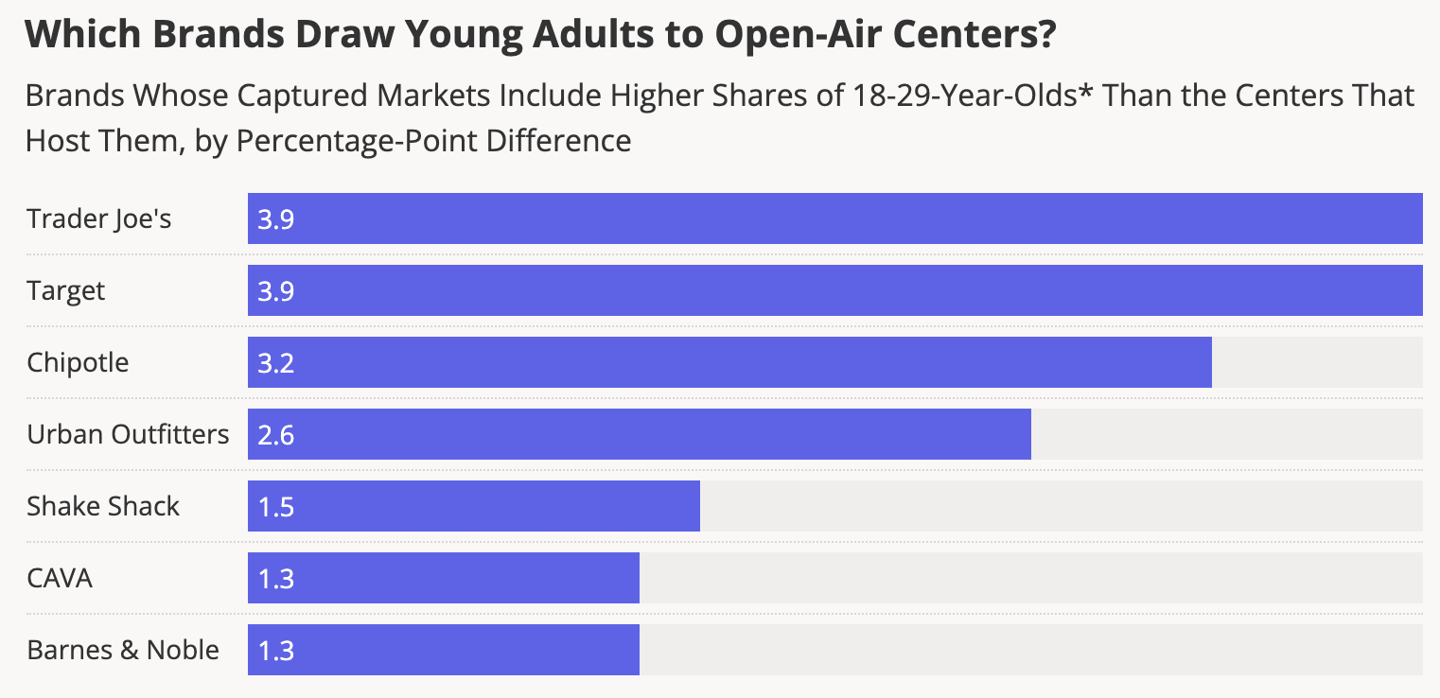
“Tenants that attract a higher share of young adults than their host centers may help strengthen a property’s Gen Z profile,” noted Placer.ai. “And a chain that overindexes relative to its host centers can demonstrate its appeal to young adults – a useful point of leverage in lease negotiations and site-selection decisions.”
Comparing the 10% of properties in the Placer.ai Indoor Mall Index with the highest shares of Gen Z visitors against the rest of the index revealed a pattern of shorter, more frequent visits, Placer.ai found.
From January to September, 12.5% of visitors to these Gen Z-heavy malls made at least three visits in an average month. This is compared with 10.2% at other malls. Gen Z visitors also spent less time on-site, with an average dwell time of 60.5 minutes compared to 73.3 minutes across the rest of the index.
Over the same period, malls that attracted more Gen Z shoppers drew a larger share of visits during off-peak morning and midday hours, with 29.3% occurring between 9:00 a.m. and 2:00 p.m., compared with 27.2% at other malls. They also received a greater share of traffic on weekdays (62.8% versus 60.8%) when mall visits are more likely to involve errands and routine stops.
Placer.ai’s full white paper can be found here.