
Eddie Bauer files for bankruptcy: Why 'now' matters
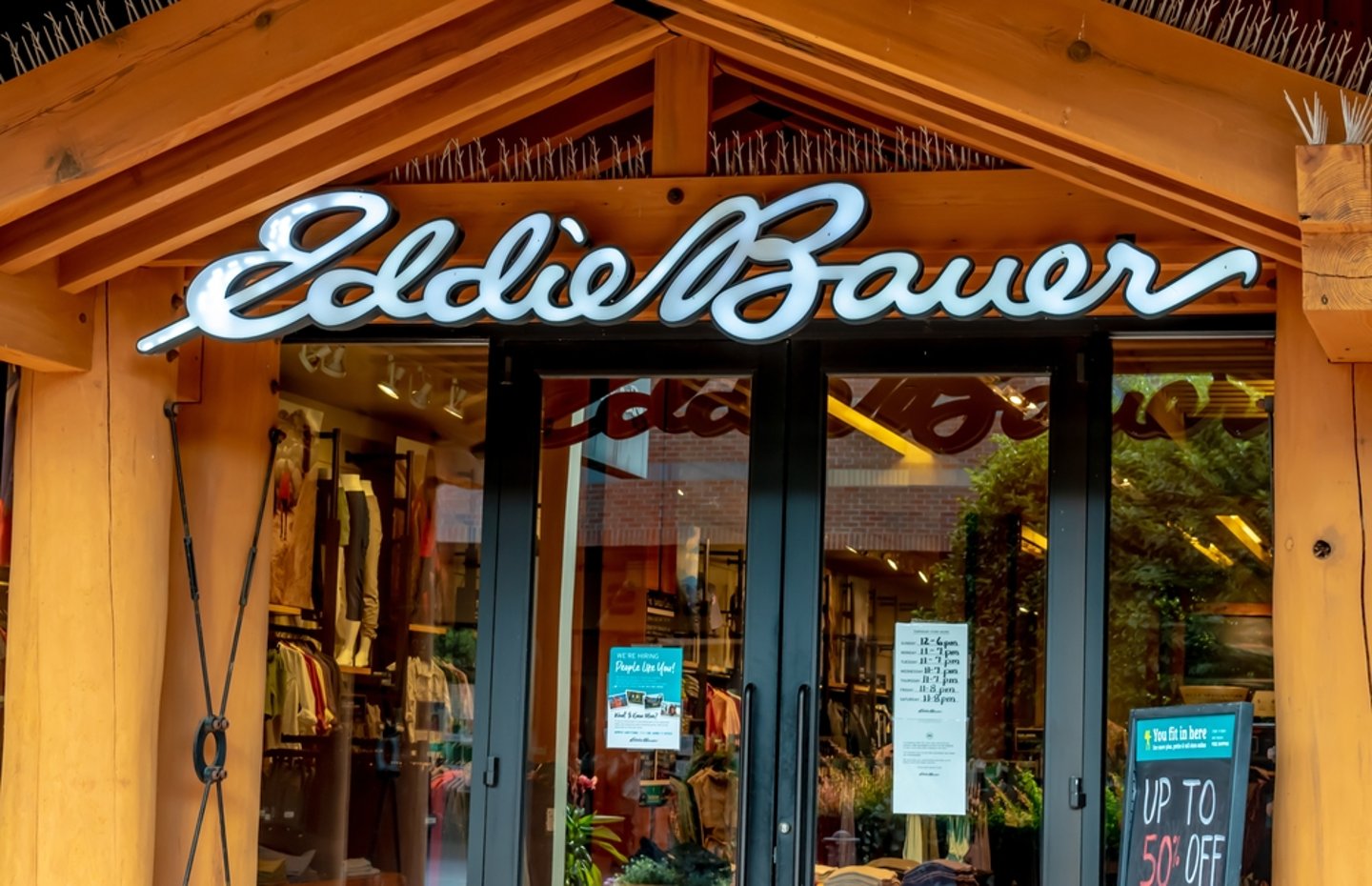
The operator of Eddie Bauer stores in the United States and Canada has filed for Chapter 11 bankruptcy protection.
That sentence is precise for a reason. This filing does not place the entire Eddie Bauer brand into bankruptcy. It does not shut down e-commerce. It does not affect international licensees. It applies specifically to the North American brick-and-mortar retail operator.
This is not a brand collapse. It is a targeted restructuring — or possible elimination — of the physical store fleet following the separation of digital operations into a separate entity. That distinction explains both how the company arrived here and why this filing matters beyond a single retailer.
[READ MORE: RCS selected as Eddie Bauer LLC's real estate consultant for bankruptcy]
Eddie Bauer’s case illustrates how retailers are isolating store-level risk while preserving brand value, intellectual property, and scalable digital revenue streams. Put differently: the company has concluded that physical stores are the risky asset.
The Structure Behind the Filing
Over the past several years, Eddie Bauer’s operations were divided across separate entities. The North American retail stores operated under Catalyst Brands. Meanwhile, e-commerce and wholesale operations were transitioned to Outdoor 5 LLC — a structure reminiscent of the divisive merger often referred to as the “Texas Two-Step.”
That separation reshaped the company’s risk profile. When digital and wholesale channels sit outside the entity that files for bankruptcy, the filing becomes surgical. It is no longer a referendum on the brand itself. It is an economic evaluation of the store fleet.
Physical retail carries fixed costs that do not adjust easily when consumer behavior shifts. Lease obligations, common area maintenance charges, occupancy costs, and staffing remain largely constant regardless of short-term traffic fluctuations. Even modest productivity declines can create disproportionate strain when costs are fixed.
E-commerce, by contrast, is more elastic. Distribution, staffing, and fulfillment can scale with demand — or be outsourced entirely. The fact that those operations are not part of this filing underscores the central reality: this is a store-driven restructuring, not a brand-driven one.
A Court-Supervised Sale, Not Just a Reset
The company is using Chapter 11 to conduct a court-supervised sale process. The stated goal is a going-concern transaction for the retail business. If that fails, the alternative is an orderly wind-down. That posture matters.
Traditional reorganizations assume the existing operator can restructure debt and leases and continue independently. Those cases are increasingly rare. Modern retail Chapter 11s tend to be sale-driven, often moving quickly toward new ownership — sometimes the existing lender — with varying degrees of confidence in the underlying business model.
Retail bankruptcies move quickly because inventory is a wasting asset. Holding inventory too long compresses margins and erodes recoveries. More importantly, it consumes cash — the most precious resource in a restructuring. A court-supervised process provides transparency and structure – and it imposes deadlines.
What Is — and Is Not — Affected
The online and wholesale operations operated by Outdoor 5 LLC are not part of this Chapter 11 filing. International licensees continue to operate independently. The immediate impact is concentrated in the North American store base.
For consumers, stores may remain open during the process. For employees, uncertainty is tied specifically to store operations. For landlords and vendors, negotiations begin around lease terms, payment priority, and ongoing relationships — or, in some cases, the transition to unsecured creditor status.
The Eddie Bauer brand itself continues. Its digital presence continues uninterrupted. And the real experiment begins: will customers tolerate a retail-to-digital shift?
The Bigger Story Is Structural
Mall-based retailers face converging pressures. Fixed lease costs remain high. Borrowing rates have increased. Consumer traffic has fragmented across online platforms, off-price retailers, brand-owned digital channels and marketplaces.
These forces do not eliminate demand for brands. They challenge the economic logic of maintaining large store fleets built for an earlier retail environment.
For many retailers, stores no longer function primarily as revenue engines. They operate as marketing platforms, fulfillment nodes, or customer acquisition channels. By separating digital operations from physical retail, companies preserve scalable components of the business while isolating store-level risk.
From a lender’s perspective, isolating retail leases reduces operational complexity and financial exposure. Lease obligations introduce long-term commitments and competing claims that constrain flexibility. Separating those obligations allows capital to support operations that generate more predictable returns.
The key question becomes analytical: how much revenue is lost by exiting physical retail versus how much cost is eliminated?
A Test Case for Retail Restructuring
Eddie Bauer’s restructuring may serve as a broader test case.
For boards, lenders and investors, the questions is evolving. It is no longer simply how to stabilize declining store traffic. It is whether maintaining a large physical footprint remains necessary at all. Independent digital channels provide alternative ways to maintain customer relationships without fixed real estate exposure. This approach allows companies to protect brand value while recalibrating physical presence.
What Comes Next
Early court proceedings will establish bid timelines, financing arrangements, and lease decisions. Those milestones will determine whether the store fleet survives under new ownership, operates in reduced form, or exits entirely.
Retail restructurings do not unfold in isolation. Landlords, vendors, lenders and competitors all respond quickly. Perception influences outcome.
I am exactly the customer Eddie Bauer is counting on post-bankruptcy. I buy their winter clothes every year. I do it entirely online. Since the last bankruptcy, I have entered one store exactly once — to exchange a coat for a smaller size.
For customers like me, the choice is simple. I can buy my winter wardrobe online in minutes, often while doing something else productive. The store adds friction, not value. If enough customers behave that way, the store fleet becomes an expensive artifact of a prior era.
This case reflects a broader transition underway across retail. Companies are preserving brand value while restructuring or isolating store operations that no longer align with consumer behavior or cost structures. All eyes – both from customers like me and from other retailers – will be watching what happens next.

Ted Gavin, is managing director and founding partner of Gavin/Solmonese, a financial advisory consultancy specializing in bankruptcy and fraud investigations with an assertive, hands-on approach.