CoStar: Retail vacancy to rise before end of year

Retail vacancy is “balanced” to start 2026.
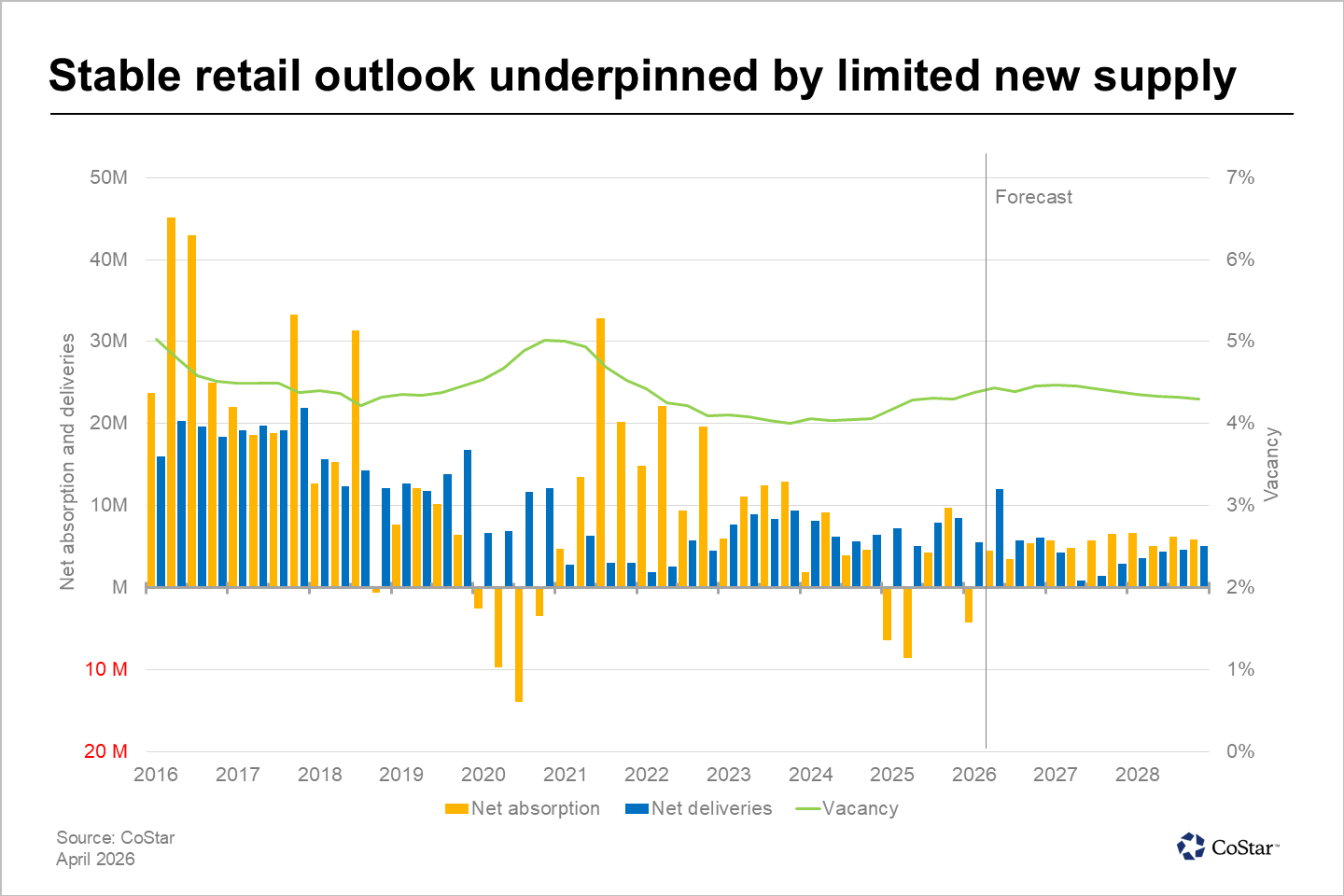
That’s according to new data from CoStar Group, which found that U.S. retail vacancy is anticipated to peak in the mid-4.4% range, with projections to increase slightly in 2026 before “stabilizing and gradually tightening” next year.
CoStar predicts that net absorption is forecasted to remain modest through the first half of 2026 before improving in the latter half of the year. An average of between 4 to 5 million square feet of space is expected to be absorbed per quarter.
[READ MORE: CoStar: Retail rent growth slows to 1.9% in Q1]
“Move outs rose in Q1 2026 following a quieter close to 2025,” said Brandon Svec, national director of retail analytics at CoStar Group. "While first quarter move outs are typically elevated, historically resulting in the weakest quarter of the year, this year’s increase was amplified by several large batch closures and a higher closure rate among mom-and-pop tenants. Store closures are expected to remain somewhat elevated in the near term as certain discretionary and value challenged retailers continue to rationalize footprints amid slower sales growth and rising operating costs.”
The steady vacancy comes as new retail construction is still at a standstill, made all the more challenging by increasing energy costs. CoStar recently revealed that in the first quarter of 2026, roughly 64.2 million square feet of retail space was under construction in the U.S., down from approximately 70 million square feet a year earlier.
“The forecast carries both downside and upside risks, though the balance remains tilted to the downside,” said Svec. “Significant uncertainty remains around the impact of increased oil and gas prices on an already fragile customer. Other downside risks include a further softening in the labor market and lower-than-expected population gains.”
CoStar’s full forecast can be found here.