
Placer.ai: States that saw the highest migration in 2025 were...

Migration trends cooled in 2025, but the states that did attract new residents were smaller ones.
That’s according to a recent report from Placer.ai, which found that no state recorded net inflows or outflows exceeding 0.7% of its starting population last year. Several smaller states continued to attract new residents at meaningful rates, but none of the nation's six most populous states saw net in-migration exceed 0.2%.
South Carolina and Delaware led the nation with net in-migration equal to 0.7% of their populations in 2025, followed by Idaho (0.6%), Maine (0.5%), Tennessee (0.4%) and North Carolina (0.3%). Placer.ai said that for most of these states, migration accelerated relative to 2024, though Delaware's inflow rate moderated slightly and North Carolina held steady.
Commonalities of these states include a similar mix of lifestyle amenities, relatively low congestion, and opportunities for growth, according to the report. Many also benefit from business-friendly climates, favorable tax policies, or housing costs that remain attractive relative to the higher-cost markets.
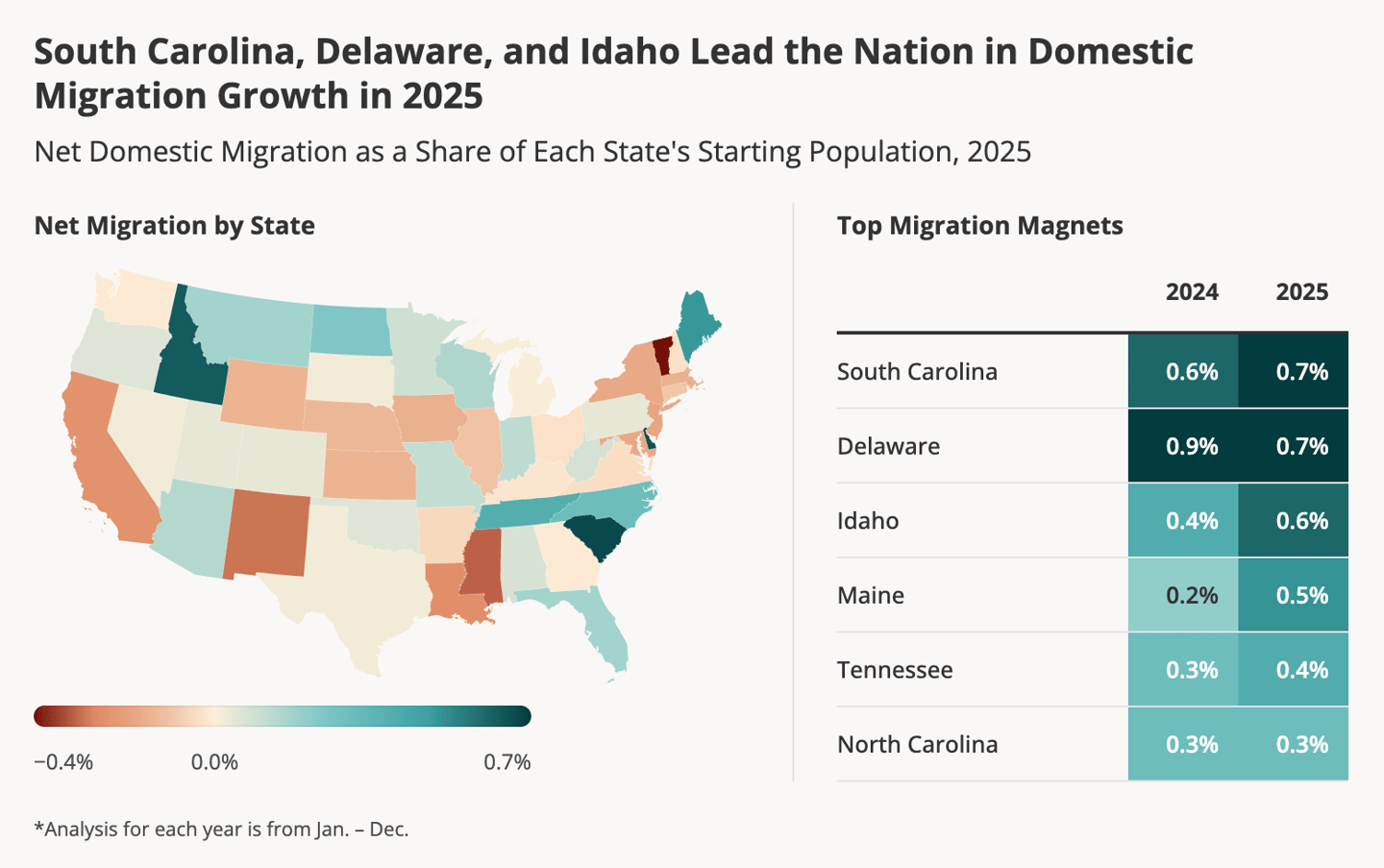
Among the nation's six most populous states, Florida was the only one to see accelerating net in-migration in 2025, attracting new residents equal to 0.2% of its starting population. This was an increase from 0.1% the year before.
On the other hand, Texas slowed from 0.1% net in-migration in 2024 to essentially flat in 2025, highlighting the cooling of what was once one of the country's strongest pandemic-era destinations, according to the report.
[READ MORE: Placer.ai: Retail giants continue gaining share of store visits]
Illinois and California have seen their migration deficits steadily narrow, with further improvement in 2025. Between 2022 and 2025, Illinois moved from -0.8% to -0.1%, while California moved from -0.9% to -0.2%. New York has held steady at -0.2% over the past two years, and Placer.ai says this marks a significant moderation from 2022, when the state experienced net outmigration equal to 1.1% of its population.
Several metros are attracting residents through in-state migration even when their states as a whole are experiencing little or no net migration growth. Placer.ai cited Phoenix (+0.3%) and Dallas (+0.2%) as the leading examples.
The report noted that metro-level data also suggests that the pandemic-era "big-city exodus" narrative is continuing to dissipate. Los Angeles improved from -0.8% in 2023 to -0.3% in 2025, while New York held steady at -0.3% after improving in 2024.
Miami (-0.6%), which ranked last among major metros despite Florida's continued statewide gains, saw its outflows moderate from 2023 levels. Chicago (0.0%) reached migration neutrality in 2025 after recording losses in both 2023 and 2024.
“The pandemic-era urban exodus is giving way to a more nuanced migration landscape,” said Placer.ai. “Large urban markets are stabilizing, while growth is increasingly concentrated in smaller states, secondary metros and intra-state corridors. Affordability remains a powerful pull, but retirees, lifestyle considerations, and local market dynamics are also playing an increasingly important role in where Americans choose to live.”
Placer.ai’s “Migration After the Boom: Where Americans Are Moving in 2026” can be found here.